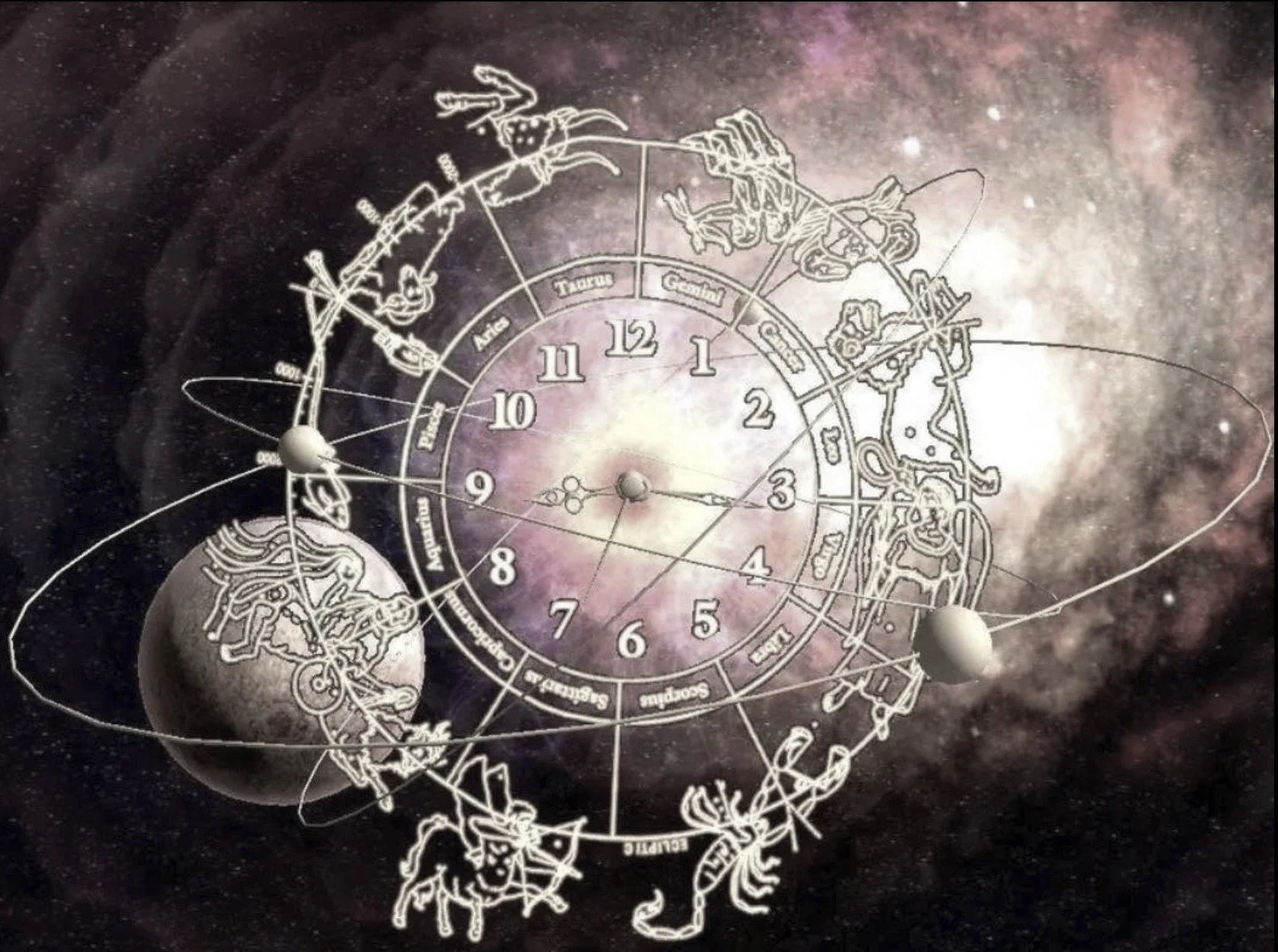
What is astrology anyway?
When the subject of astrology comes up in conversation, most people think of the horoscopes published in mainstream media, which are based solely on a person's sun sign. These horoscopes often fail to resonate or ring true, which is partly why some people dismiss astrology as "mumbo-jumbo." What many don’t realize is that these mainstream horoscopes are limited because they ignore the other placements in a person's birth chart that make them unique. Astrology is so much more than just a sun sign! In fact, the sun sign isn’t even the most important placement in a birth chart—it’s simply the easiest to identify and the most recognizable. While people of the same sun sign may share some core traits, they can be vastly different due to the influence of other planetary placements.
Astrology is defined as "the study of the movements and relative positions of celestial bodies interpreted as having an influence on human affairs and the natural world." It was practiced over 4,000 years ago in Babylon (c. 3rd–2nd millennium BCE) as a system of celestial omens to predict weather and political events, often indistinguishable from early astronomy. Astrology spread to Greece, Rome, and India, evolving into natal astrology (individual horoscopes or birth charts) by the 1st century BCE. Once considered a respected science, it declined during the 17th-century Enlightenment but experienced a popular resurgence in the 20th century.
Even Carl Jung was a practicing astrologer. He referred to astrology as "the science of antiquity" and recognized it as a tool that provides a psychological description of one's character. Jung acknowledged the effect of transiting planets and celestial bodies on a person's character, which can explain, in part, the change and growth a person undergoes over their lifetime. Just as the moon’s energy affects the tides on Earth, the energies of planets and celestial bodies (including the moon) influence one's character, emotions, and behaviors. Jung conducted studies of married couples by examining their birth charts and identifying the influences of planetary and celestial aspects on their relationships. He also used astrology to study the unconscious mind and society at the collective level. Truly, astrology and psychology go hand in hand.
Astrology provides a framework for self-reflection and allows for the identification of patterns—both positive and negative. It can be used to understand a person's personality, strengths, and challenges at both the conscious and unconscious levels. Astrology can help identify dominant personality traits and behavioral tendencies including repetitive patterns, as well as provide insight into potential challenges one may face in all aspects of life. Studying and understanding upcoming transits can help a person prepare for the energies that may influence certain areas of their life. Just because modern science and technology lack a mechanism to measure or quantify the energies emitted from planets and celestial bodies and their specific effects on a person doesn’t mean astrology doesn’t work. The experiences of many, including Carl Jung and myself, provide evidence enough. I am confident that one day science and technology will catch up.
Sources:
Oxford Languages. (n.d.). Definition of Astrology in Google Dictionary. Retrieved February 8, 2026, from <https://www.google.com/search?client=firefox-b-1-d&q=astrology+definition>
Jung, C.G. (1952), “Synchronicity: An Acausal Connecting Principle," Collected Works 8. Princeton: Princeton University Press.
Jung, C.G. (1960), ”The Structure and Dynamics of the Psyche,” Collected Works 8. Princeton: Princeton University Press.
Jung, C.G. (1970), “Civilization in Transition,” Collected Works 10. Princeton: Princeton University Press.